
Project details:
This project builds a classification model that recommends the most suitable mobile tariff for telecom users based on their monthly activity. Call duration, messages and internet usage were analysed to train and evaluate several algorithms. The final model reaches strong accuracy and provides a practical tool for upgrading users to better-fitting plans.
Description
Business Context & Problem
Telecom companies often lose revenue when customers use plans that don’t match their real communication needs. Some users overpay for unused allowances, while others exceed their limits and generate dissatisfaction. A recommendation system helps both the company and the customer by suggesting a plan that aligns with actual usage. This project focuses on building such a classification model using historical behavioural data.
Data & Analytical Approach
The dataset included monthly usage metrics: call minutes, number of SMS messages and internet traffic. After cleaning and preparing the data, basic exploration revealed clear behavioural patterns between the two available tariffs. Feature distributions were reviewed, outliers were handled and the data was split into training, validation and test sets. Standard preprocessing methods ensured that all features were ready for modelling.
Statistical / ML Analysis
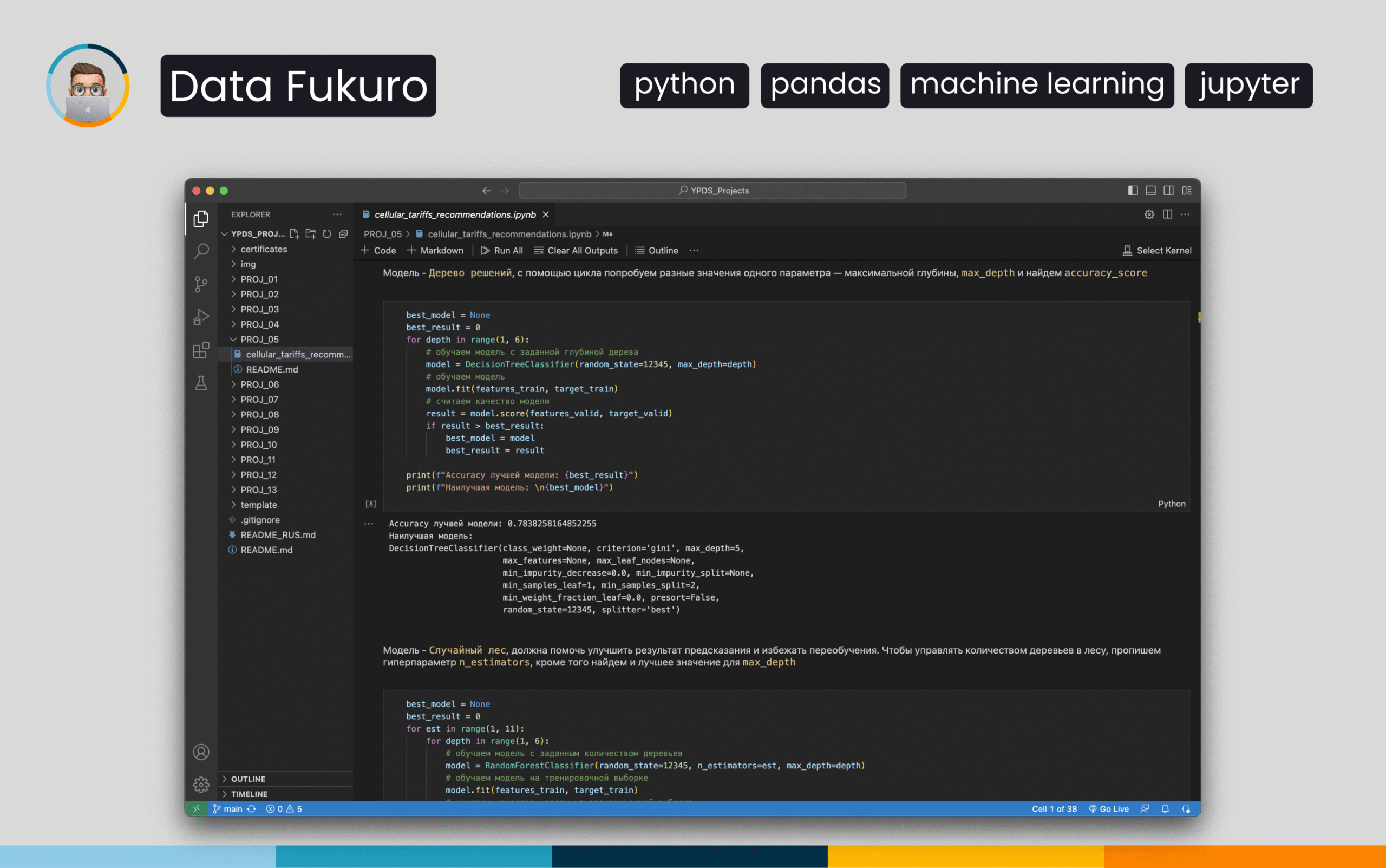
Several classification algorithms were tested using Scikit-learn to determine which one performs best for this recommendation task. Hyperparameters were tuned through grid search and cross-validation to stabilise accuracy and avoid overfitting. The final model achieved an accuracy level above the required threshold (0.75) and performed consistently on the unseen test sample, providing confidence in its generalisation.
Key Insights & Final Recommendations
User behaviour proved to be highly predictive: customers with heavy internet use and longer calls aligned strongly with one tariff, while more balanced users fit the alternative plan. The best-performing model can be integrated into a customer-facing recommendation system or used by support agents during consultations.
Overall, the project demonstrates a practical machine-learning solution that helps a telecom provider improve customer satisfaction and optimise plan distribution.